The winners of The smarter E AWARD 2026 have been chosen. On the eve of Europe’s largest alliance of exhibitions for the energy industry, the pioneers of an advanced energy world received awards at the ICM Munich in five categories: Photovoltaics, Energy Storage, E-Mobility, Smart Integrated Energy and Outstanding Projects. The award-winners are cleverly and boldly paving the way to a world of renewable energy and mobility. A high-caliber panel of experts made the selection from a record number of international submissions of visionary products, solutions and projects for the popular award. Visitors will have the opportunity to experience the innovative solutions first-hand and talk to award-winners from 23–25 June, 2026, when The smarter E Europe opens its doors at the Messe München.
Europe’s largest alliance of exhibitions for the energy industry combines the key topics for a 24/7 renewable energy supply across all sectors and industries with its four exhibitions: Intersolar Europe, ees Europe, Power2Drive Europe and EM-Power Europe. With around 2,800 exhibitors and over 100,000 visitors expected over these three days, Munich will once more become the international meeting point for the global energy transition.
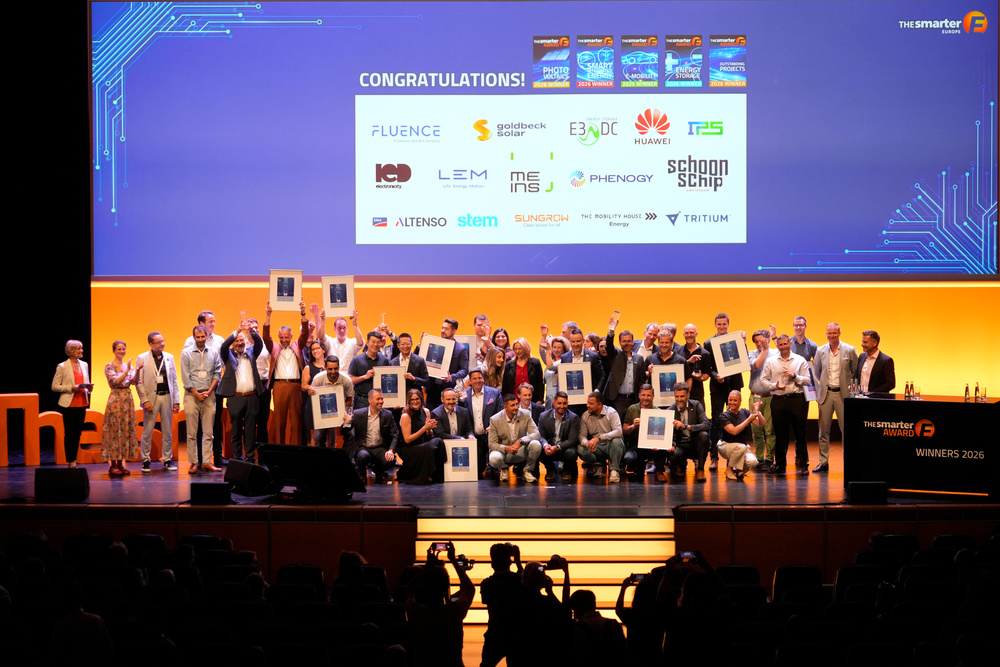
The prize is an amazing chance for the winning businesses to raise their status and receive international recognition. Their solutions focus on the current trends and challenges of the energy transition. Large amounts of renewable energy need to be integrated intelligently into existing infrastructure. And above all else, the energy transition is a global endeavor – this is shown by the five award categories. Three businesses in each category will receive The smarter E AWARD 2026.
HeliomatiX is an automated construction system for large-scale photovoltaics installations. It combines a preassembled plant, autonomous transport vehicles and a robotic mounting system, which can reduce the labor required on site by up to 85 percent. The panel recognizes the impressive innovation at the system level and the added value it brings.
The extraordinary high-performance solar string inverter has a power density of almost 1.5 MW/m3. In large-scale PV plants it produces 506 kilowatts AC and has a maximum efficiency of over 99 percent. The panelists commended the outstanding power density, the efficiency curve and the resource-conserving design.
True Wind is an intelligent wind monitoring and security system for horizontal single-axis PV tracking systems. Instead of relying on external wind data, it measures the vibrations and torsions of each tracking system and rotates the entire PV system during strong winds. This reduces yield losses and prevents damage.
EXERON CheckMate is a bidirectional inverter for supply-scale battery energy storage systems (BESS). It comes in two variants which both offer a power density of 3.3 megawatts per cubic meter. The panel commended CheckMate’s impressive power electronics, environmental footprint and grid-forming capabilities.
The PHENOGY 1 series is a sodium-ion BESS and marks a new milestone in battery technology. The batteries are more environment-friendly because they do not contain lithium or graphite. Their higher temperature stability and cooling system ensure safer operation and over 10,000 complete charging cycles. A pilot system came into operation in 2025 in Bremen, the largest of its kind in Europe.
PowerTitan 3.0 is a containerized BESS for large-scale use. Every 20 foot unit provides over 1.87 megawatt PCS and 7.14 megawatt hours of lithium-ion batteries. The panel praised the 92 percent round-trip efficiency, price-performance ratio and the grid stability functions.
The bidirectional EV charger edsn is a V2G-capable DC charging device. It uses OCPP and Modbus to form an important interface between the household power supply, electric vehicle and electricity market. Car batteries store solar energy and can supply an entire house with power, also when in grid backup mode. The panel applauds the EV charger’s simple design, its broad compatibility and support for low carbon mobility.
The DCES series is a DC energy meter for fast charging and megawatt charging systems. It offers a simple plug and play installation, wireless monitoring and precise billing in kilowatt hours. It works especially well for the fast charging of electric trucks and meets the demand for charging solutions. Furthermore, it ensures reliable data protection for end users.
TRI-FLEX is a modular fast-charging system with DC-coupled BESS integration. Each scalable TRI-FLEX platform can supply up to 3.2 megawatts DC and charge 64 electric vehicles at the same time. It is ideal for company fleets and public charging centers and stands out as an intelligent, flexible, future-proof charging solution.
CSET is an ultracompact high voltage station for smart grids, solar and wind energy and BESS. It is made up of an electric switchgear on the inside, an external transformer and wireless monitoring for predictive maintenance. The panelists praised the innovative and cost-effective CSET for industrializing the grid connection and advancing the energy transition.
Stem PowerTrack is an edge-to-cloud energy management system for large-scale PV plants, energy storage and hybrid plants. The integrated platform combines energy monitoring with grid-conforming power plant controllers. The panel were impressed by the holistic design, the 99.99 percent uptime, cybersecurity measures, the low latency and the broad market potential.
The V2G Flex Platform brings electric vehicles, bidirectional charging devices, utility companies and energy markets together into one software ecosystem. With smart and V2G charging, users can generate revenue while supporting the power grid, allowing consumers to play an active role in the energy transition.
The Russian invasion of Ukraine triggered an energy crisis, which lead to an increased demand for decentralized energy sources across Europe. Working together with utility company DTEK, Fluence remotely brought six decentralized, utility-scale BESS plants into operation, which can provide 600,000 households with emergency electricity. The project shows how decentralized BESS plants can provide energy security.
Schoonschip is an energy community in the North of Amsterdam. The decentralized microgrid with 46 housing units uses solar energy, battery storage and water heat pumps, optimizes self-consumption, uses day-ahead prices and offers up to 80 kilowatts of flexibility. The panel praised the elegant design, the potential for urban consolidation, the ecological advantages and the measurable social value.
In Namibia, SMA Altenso contributed to creating Africa’s first solar-operated plant for green hydrogen. It combines a large PV system, a 5.9 megawatt hour battery storage system and a 5 megawatt electrolyzer. The hydrogen is used on site for dual-fuel trucks, buses, power generators, and soon for a locomotive engine. The panel described the project as a glowing example of a sustainable energy ecosystem.